





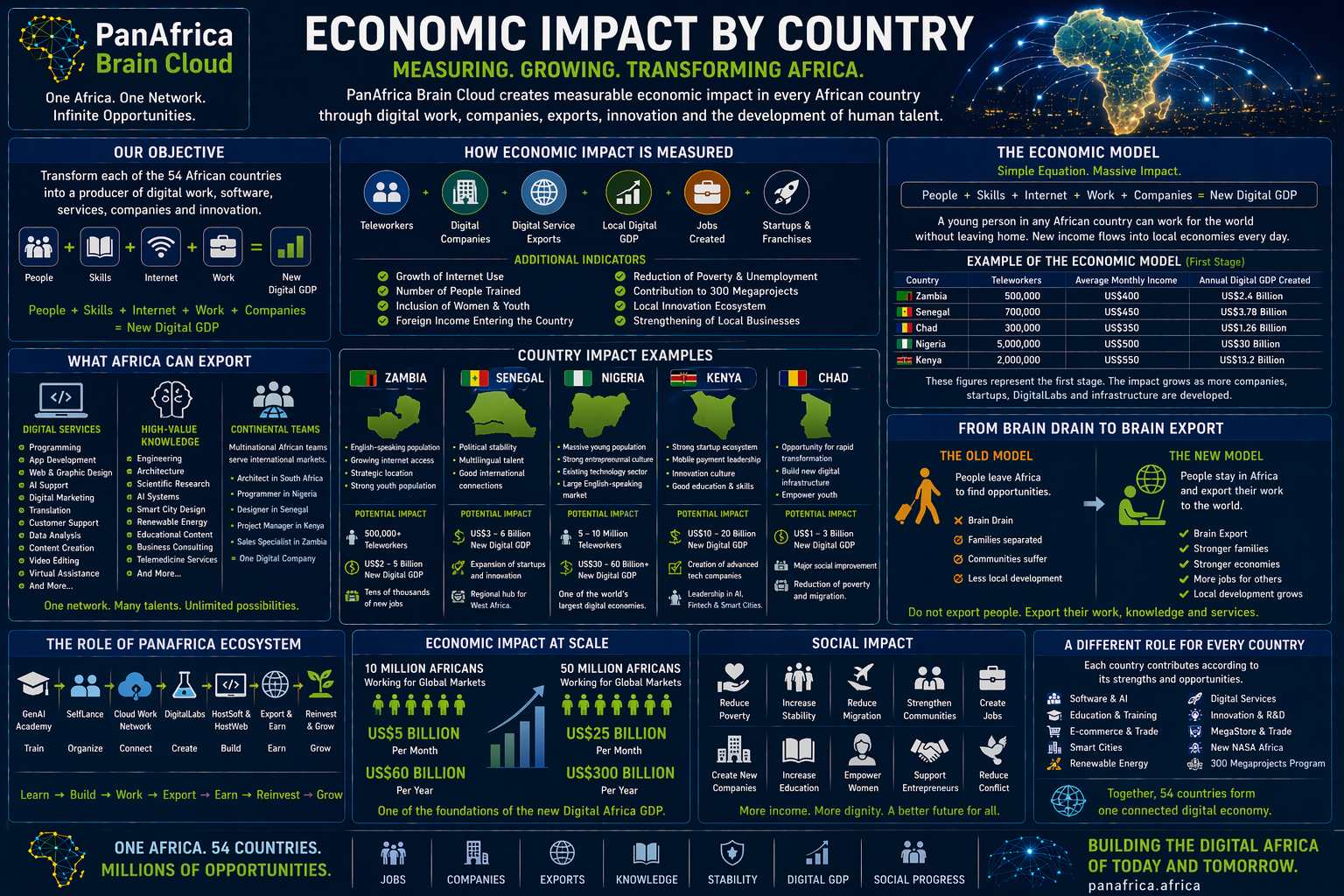
One of the most important objectives of PanAfrica Brain Cloud is to create measurable economic impact in every African country.
Each nation has different strengths, population, internet access, education levels and economic conditions. For this reason, the system does not use one identical model for all 54 countries. Instead, it creates a specific digital growth strategy for each country.
The objective is simple:
Transform each country into a producer of digital work, software, services, companies and innovation.
How Economic Impact Is Measured
The PanAfrica system measures the economic impact of each country through six key indicators:
- Number of teleworkers
- Number of digital companies
- Export of digital services
- Local digital GDP generated
- Jobs created
- New startups and franchises
Additional indicators include:
- Growth of internet use
- Number of people trained
- Number of women and young people included
- Amount of foreign income entering the country
- Reduction of poverty and unemployment
- Contribution to the 300 Megaprojects Program
Example of the Economic Model
The system uses a simple equation:
People + Skills + Internet + Work + Companies = New Digital GDP
This allows each country to calculate its own potential based on population and digital participation.
For example:
| Country | Teleworkers | Average Monthly Income | Annual Digital GDP Created |
|---|---|---|---|
| Zambia | 500,000 | US$400 | US$2.4 Billion |
| Senegal | 700,000 | US$450 | US$3.78 Billion |
| Chad | 300,000 | US$350 | US$1.26 Billion |
| Nigeria | 5,000,000 | US$500 | US$30 Billion |
| Kenya | 2,000,000 | US$550 | US$13.2 Billion |
These figures only represent the first stage of the model. As more companies, startups, DigitalLabs and micro data centers are created, the impact becomes much larger.
Zambia
Zambia can become one of the first strategic nodes of PanAfrica Brain Cloud.
Its advantages include:
- English-speaking population
- Growing internet access
- Strategic location in Southern Africa
- Strong youth population
- Opportunity to create telework, support services and digital companies
The first phase could create:
- 500,000 teleworkers
- Thousands of new small companies
- National GenAI Academy centers
- Digital service exports to English-speaking markets
Estimated annual impact:
- US$2–5 Billion in new Digital GDP
- Tens of thousands of new jobs
- Stronger middle class and local entrepreneurship
Senegal
Senegal has strong potential as a West African digital hub because of:
- Political stability
- Good international connections
- French and multilingual talent
- Growing startup ecosystem
The country can become a major center for:
- Digital services in French-speaking Africa
- Customer support
- Translation
- Software development
- Online education
Estimated annual impact:
- US$3–6 Billion in new Digital GDP
- Expansion of technology startups
- New regional leadership in West Africa
Nigeria
Nigeria has the largest population and one of the largest digital potentials in Africa.
Its strengths include:
- Massive young population
- Strong entrepreneurial culture
- Existing technology sector
- Large English-speaking market
Nigeria could become one of the largest digital economies in the world if only a small percentage of its population enters the PanAfrica network.
Possible impact:
- 5–10 million teleworkers
- Tens of thousands of startups
- Major software and AI exports
- US$30–60 Billion or more in new Digital GDP
Nigeria could become one of the central engines of PanAfrica Brain Cloud.
Kenya
Kenya already has a strong reputation in technology and innovation.
Its advantages include:
- Existing startup ecosystem
- Mobile payment leadership
- Technology hubs and innovation culture
- Strong education and English-language skills
Kenya can specialize in:
- AI services
- Fintech
- Smart cities
- DigitalLabs
- Software exports
Estimated impact:
- US$10–20 Billion in new Digital GDP
- Creation of advanced technology companies
- Strong integration with New NASA Africa and the 300 Megaprojects Program
Chad
Chad currently has lower digital infrastructure, but this creates an opportunity for rapid transformation.
With PanAfrica Brain Cloud, Chad can develop:
- New internet and cloud infrastructure
- Telework centers
- GenAI Academy programs
- YoungSoftPower youth initiatives
- Small digital companies
The first results may be smaller, but the long-term impact can be very large because the country begins from a low base.
Estimated impact:
- US$1–3 Billion in new Digital GDP
- Major social improvement
- Reduction of poverty and migration
- Integration into the continental economy
A Different Role for Every Country
Not every country needs to do exactly the same thing.
Some countries may specialize in:
- Software
- AI
- Digital services
- Education
- E-commerce
- Smart cities
- Renewable energy
- Trade Network Global
- MegaStore
- New NASA Africa
- The 300 Megaprojects Program
Together, the 54 countries form one connected digital economy where each country contributes according to its strengths.
Continental Impact
If all 54 countries participate, PanAfrica Brain Cloud could create:
- Tens of millions of jobs
- Hundreds of billions of dollars in Digital GDP
- Millions of new companies
- A new African middle class
- Greater stability and lower conflict
- A continental market connected through knowledge and technology
The final objective is not only economic growth.
It is to build a stronger, more stable and more united Africa.